KUNIMORI
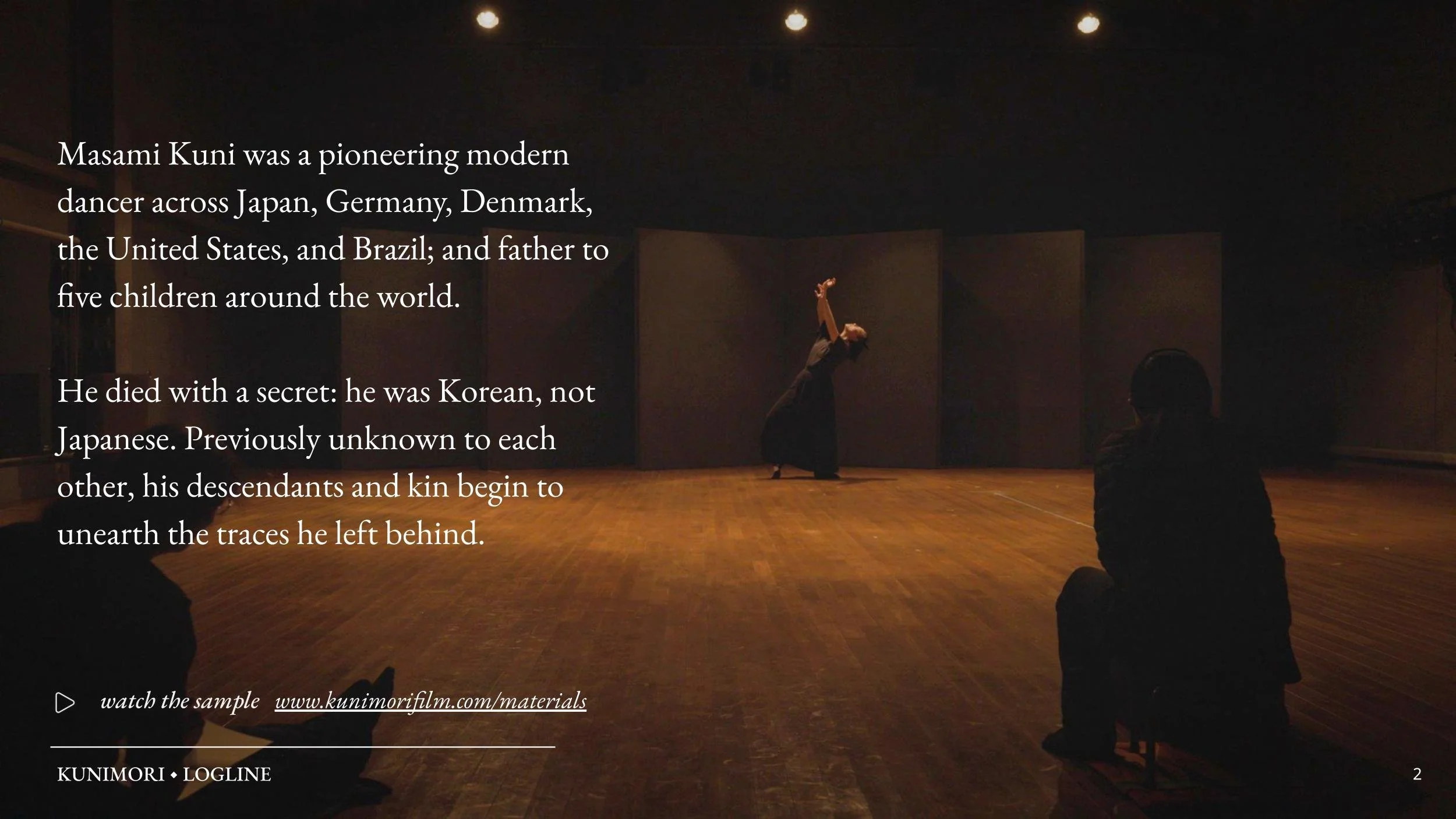
Masami Kuni was a pioneering modern dancer across Japan, Germany, Denmark, the United States, and Brazil; and father to five children around the world. He died with a secret: he was Korean, not Japanese. Previously unknown to each other, his descendants and kin begin to unearth the traces he left behind.
directed by sara yang
executive producer | bao nguyen
supported by the BAVC MediaMaker fellowship (2026)
Trailer
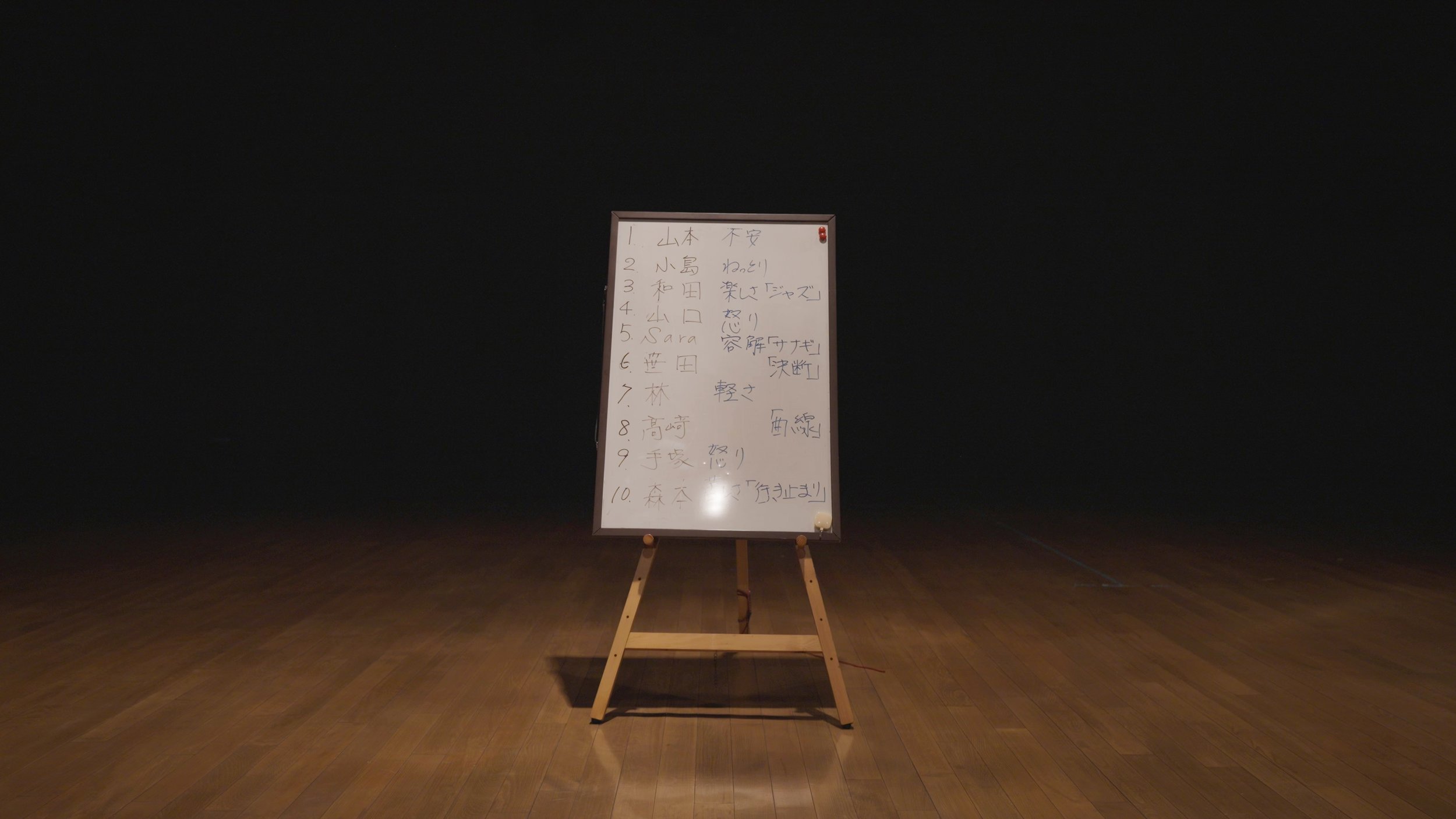
trailer runtime: 1.5 minutes
Film Sample
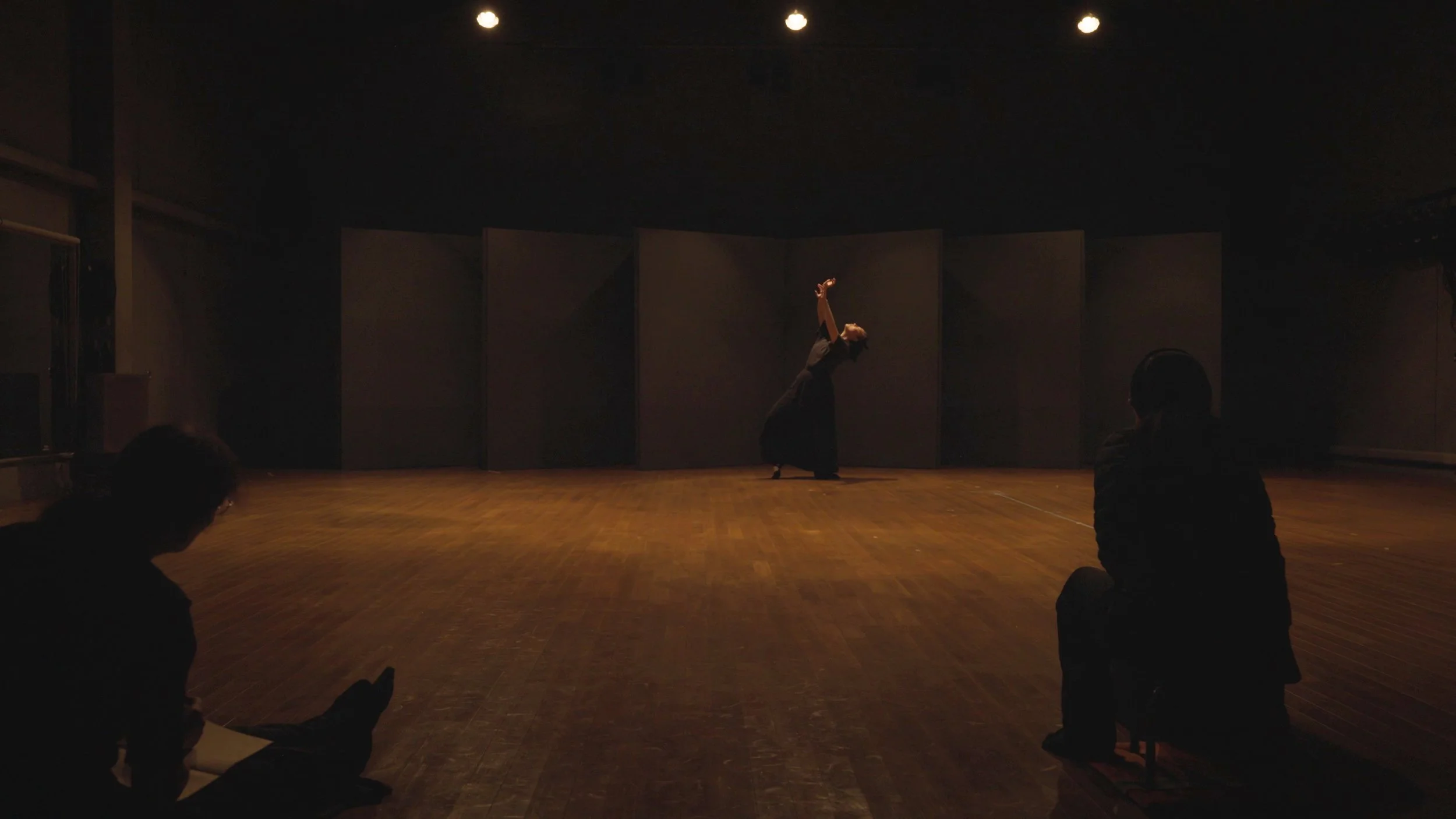
sample runtime: 16 minutes
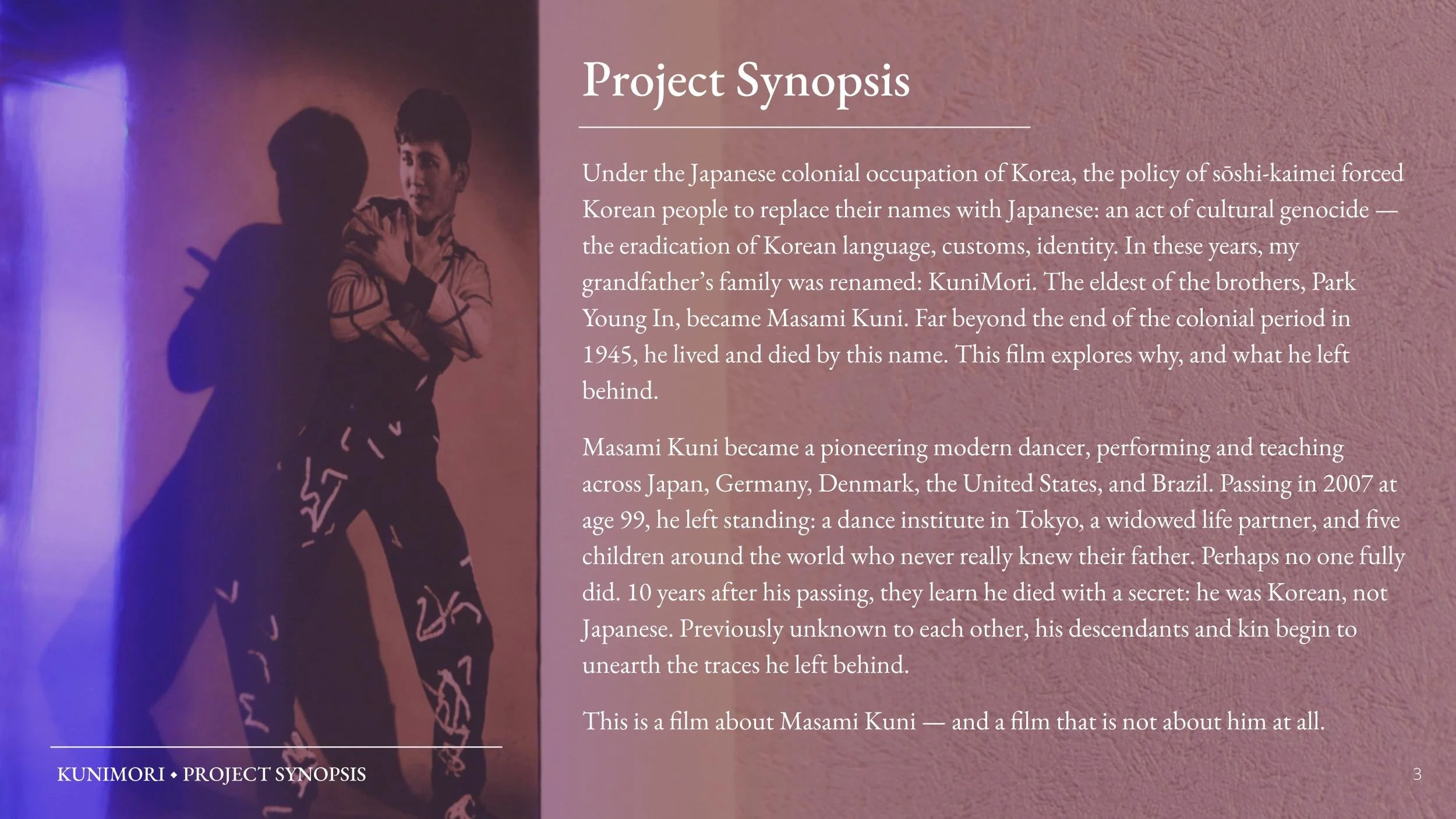
Under the Japanese colonial occupation of Korea, the policy of sōshi-kaimei forced Korean people to replace their names with Japanese: an act of cultural genocide — the eradication of Korean language, customs, identity. In these years, my grandfather’s family was renamed: KuniMori. The eldest of the brothers, Park Young In, became Masami Kuni. Far beyond the end of the colonial period in 1945, he lived and died by this name. This film explores why, and what he left behind.
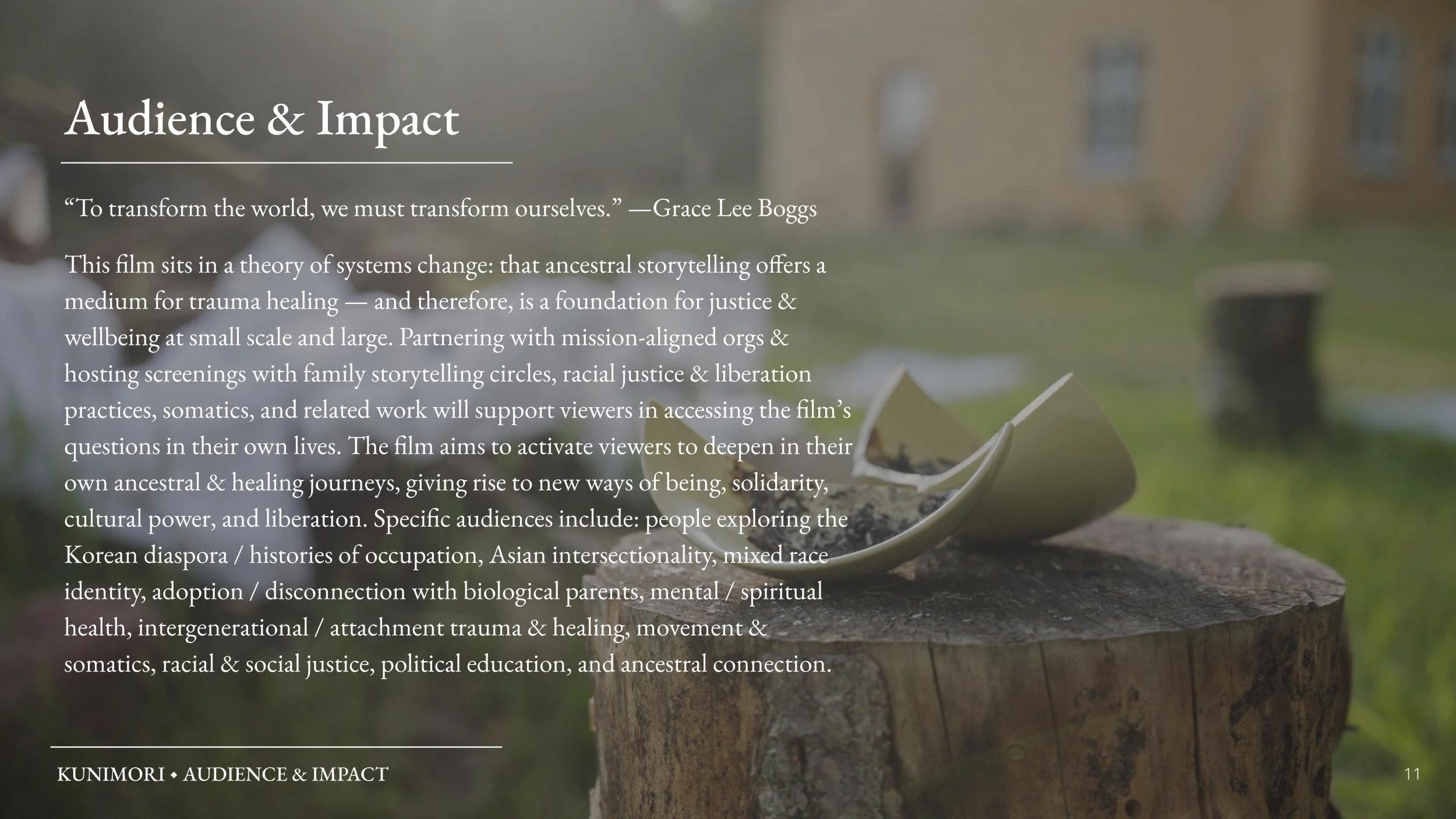
Masami Kuni became a pioneering modern dancer, performing and teaching across Japan, Germany, Denmark, the United States, and Brazil. Passing in 2007 at age 99, he left standing: a dance institute in Tokyo, a widowed life partner, and five children around the world who never really knew their father. Perhaps no one fully did. 10 years after his passing, they learn he died with a secret: that he was Korean, not Japanese. Previously unknown to each other, his descendants and kin begin to unearth the traces he left behind.
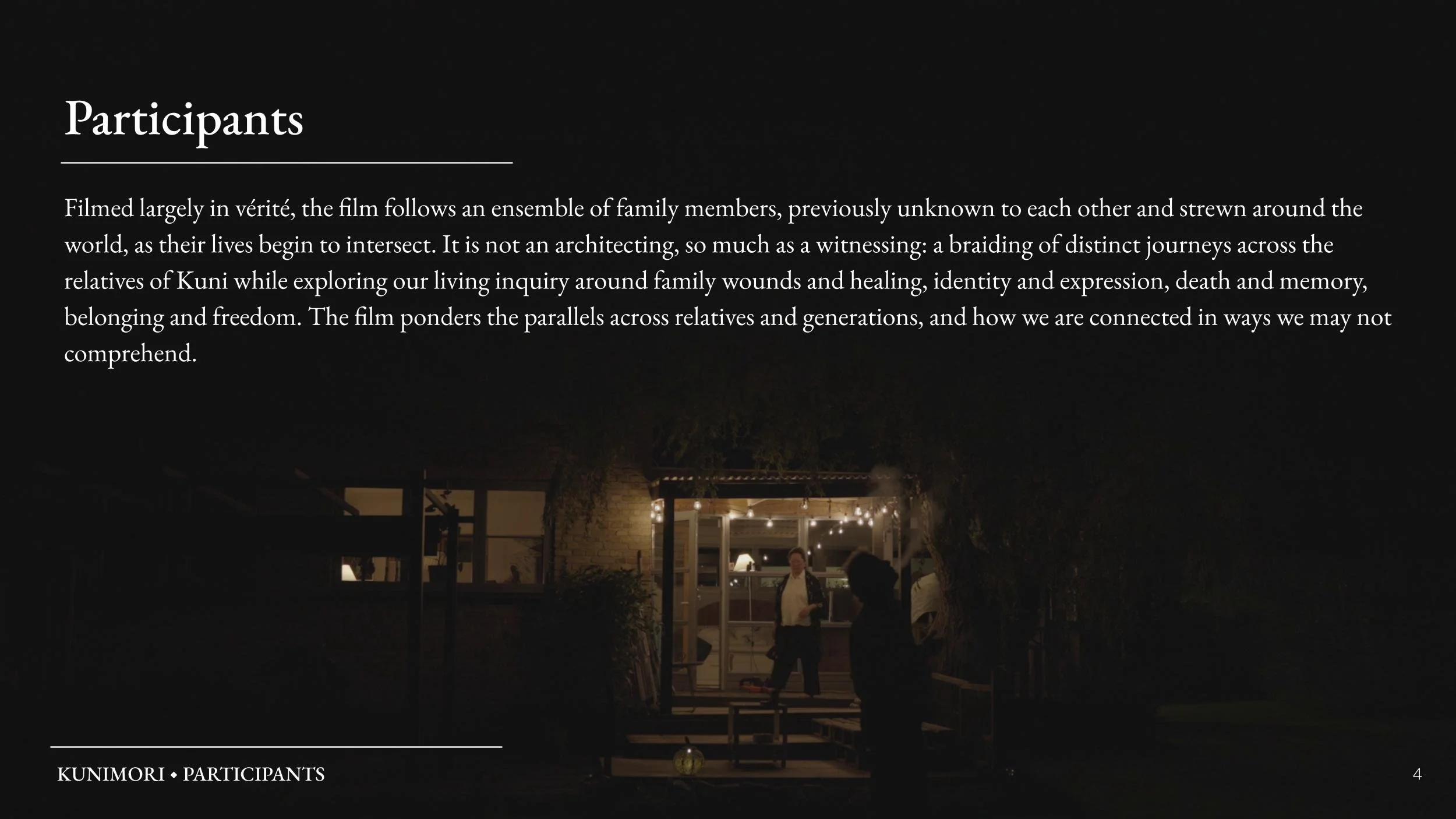
This is a film about Masami Kuni — and simultaneously, a film that is not about him at all. Filmed largely in vérité, the film is not an architecting, so much as a witnessing: a braiding of distinct journeys across the relatives of Kuni while exploring our living inquiry around family wounds and healing, identity and expression, death and memory, belonging and freedom. What is included on-screen is not a perfectly composed outcome, but the imperfect and unknown borderlands of real life. The film invites viewers into the emergent and frequently incomplete process of understanding our selves and our family’s story — for in stories we heal, individually and collectively; and in healing we get free.
directed, produced, filmed, edited by sara yang
additional filming by rachel clara reed & marisa yang
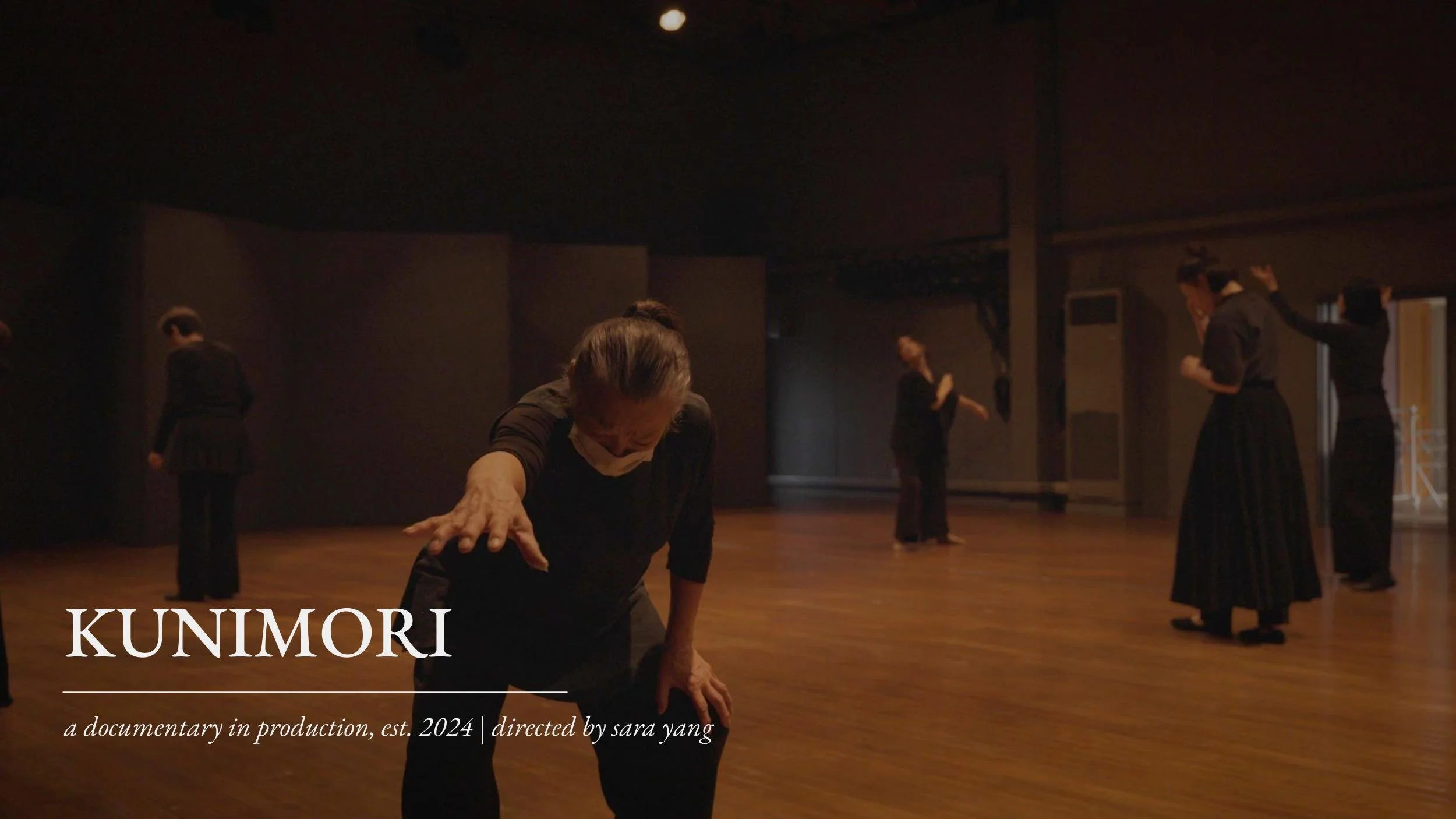
Project Overview
Preview the the topic summary, film summary, and artistic approach for KUNIMORI below.
-
Under the Japanese colonial occupation of Korea, the policy of sōshi-kaimei forced Korean people to replace their names with Japanese: an act of cultural genocide — the eradication of Korean language, customs, identity. In these years, my grandfather’s family was renamed: KuniMori. The eldest of the brothers, Park Young In, became Masami Kuni. Far beyond the end of the colonial period in 1945, he lived and died by this name. This film explores why, and what he left behind.
Masami Kuni became a pioneering modern dancer, performing and teaching across Japan, Germany, Denmark, the United States, and Brazil. Passing in 2007 at age 99, he left standing: a dance institute in Tokyo, a widowed life partner, and five children around the world who never really knew their father. Perhaps no one fully did. 10 years after his passing, they learn he died with a secret: he was Korean, not Japanese. Previously unknown to each other, his descendants and kin begin to unearth the traces he left behind.
Kuni’s legacy of mystery plays in the present in a miscellany of ways: as a relative, a shapeshifter, an artist, and an ancestor. For his descendants & family: there is a missing in their lives shaped by Kuni. These undercurrents span the attachment trauma of an absent parent; fractures in absence of a head helming the family tree; a void of children in an aging season; the reckoning of false identity in Korea’s colonized history; the loss of a partner and who you thought them to be. Yet alongside this wake, Kuni’s secrets ask if these might be the exact trails by which all are meant to find themselves, and each other.
Like a puzzle strewn across the world, his family members begin to surface the pieces of his life they each know. He was Korean, not Japanese; he was a double agent in Nazi Germany; he found a rare acceptance in the US during an age of white & black bathrooms — elusive to him in his so-called home of Japan. Kuni’s complex life and legacy offers a surface for audiences to locate ourselves in the racial, political, and spiritual fabric of the Korean & Asian diasporic experience. So often, Asian and BIPOC diasporic families shroud their history in silence. The uncommon story of our family offers a particular and universal view for how our journeys intersect in global, historical, and ongoing movements of oppression, solidarity, and liberation. Yet rather than over-indexing on our struggles, this story reaches for stranger things. It encompasses and transgresses the shadow side of the coin: a story of han (한) and healing, masking and belonging, exile and home. At a time when domination perpetuates across our world: this story resists the flattening of our stories into our trauma, and asks how we might relate with one another in ways that transcend. In today’s interlocking crises — of genocide, fascism, climate collapse, divides, collective (un)wellbeing — the film is offered as an invitation to audiences to understand our own stories and how we are related with one another. Whether this story born in Korea’s colonized past facilitates deeper solidarity with freedom movements in Palestine, Jeju, Sudan, Congo, and sites of oppression globally; or opens the courage to be with a parental wound: the film aims to be company in an arc toward solidarity, healing, and freedom. In stories we heal, individually and collectively; and in healing we get free.
As an ancestor, perhaps Kuni continues to dance on the wind, reaching into the present and willing unfinished business to bear. How do our ancestors live beyond death? As the children and grandchildren of a diaspora, the film brings into focus how identity transmutes over migrations and ages, and asks how we are connected across generations in ways that we may not comprehend.
Kuni lived his life through a mask – he donned it as survival, just as so many of us do. Our masks are wise – helping us to hide, assimilate, or even thrive – offering us a chance at a life out of reach. Yet as we become the mask, we can forget the person underneath; and it becomes impossible to imagine that the unmasked self can be safe, loved, or free. So many of our elders and ancestors have never had the opportunity to fully know oneself, and be known. Kuni’s descendants and kin confront their own masks in the present – sending ripples across generations forward and back. Unmasking is a healing: a return to the self underneath.
-
Masami Kuni was a pioneering modern dancer across Japan, Germany, Denmark, the United States, and Brazil; and father to five children around the world. He died with a secret: he was Korean, not Japanese.
This is a film about Masami Kuni — and a film that is not about him at all. His legacy of mystery offers a point of departure: we follow the distinct journeys of the relatives of Kuni, while beginning to see how they link together. As they trace his absence and presence in their lives, these may be the exact trails by which all are meant to find themselves, and each other.
Filmed largely in vérité, the film is emergent: not an architecting, so much as a witnessing – as participants explore their living inquiry around family wounds & healing, identity, death & memory, belonging, love, and freedom.
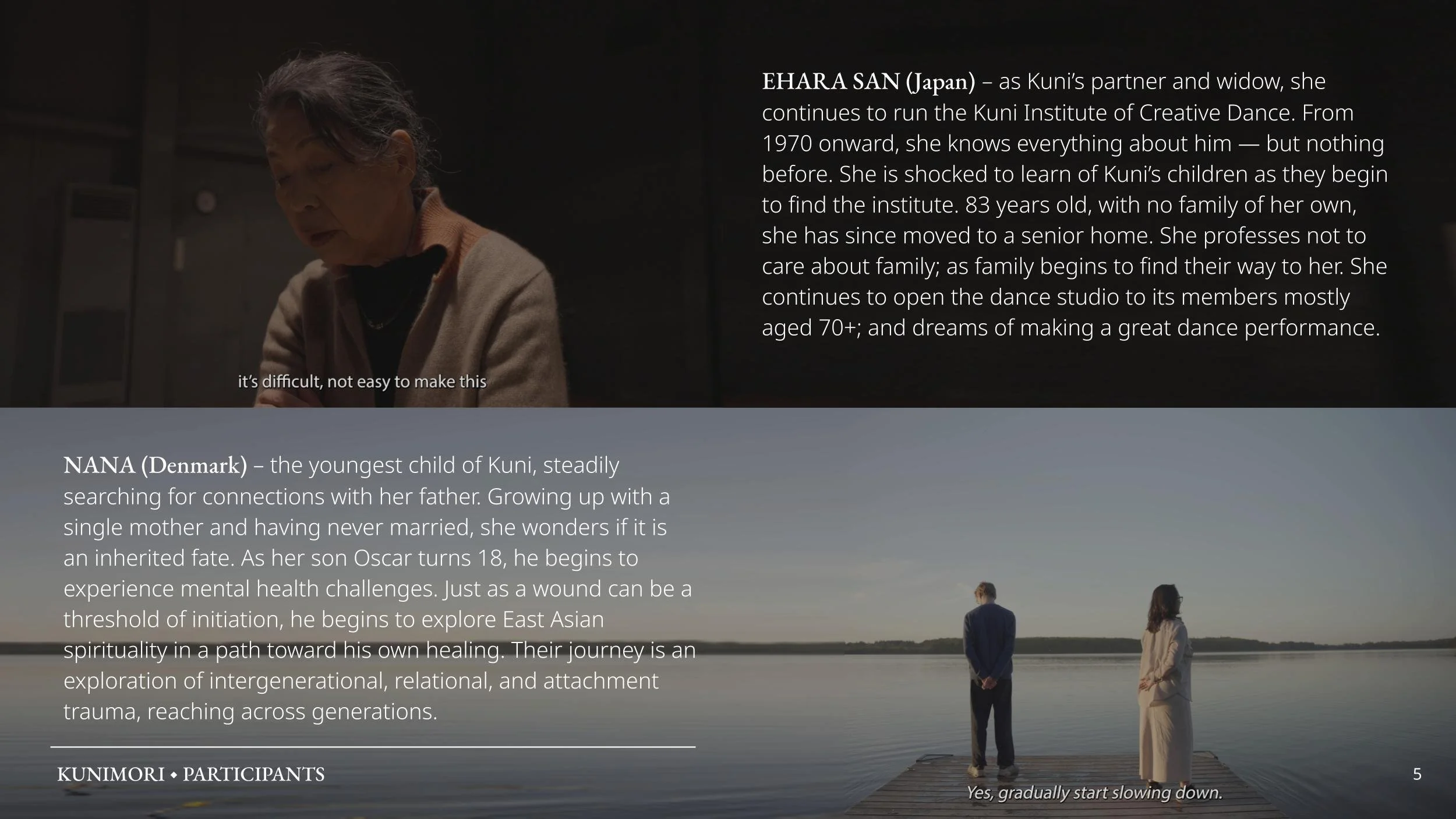
EHARA SAN (Japan) — as Kuni’s partner and widow, she continues to run the Kuni Institute of Creative Dance. From 1970 onward, she knows everything about him — but nothing before. She is shocked to learn of Kuni’s children as they begin to find the institute. 83 years old, with no family of her own, she has since moved to a senior home. She professes not to care about family; as family begins to find their way to her. She continues to open the dance studio to its members mostly aged 60+; and dreams of making a great dance performance.
NANA (Denmark) is the youngest child of Kuni, steadily searching for connections with her father. Growing up with a single mother and having never married, she wonders if it is an inherited fate. She highlights questions of attachment and relational trauma across generations. She and her children Maya and Oscar hope to travel to Japan & Korea to meet relatives & lands that are familial and unknown. As Oscar turns 18, he begins to experience mental health challenges. Just as a wound can be a threshold of initiation, he begins to explore East Asian spirituality in a path toward his own healing.
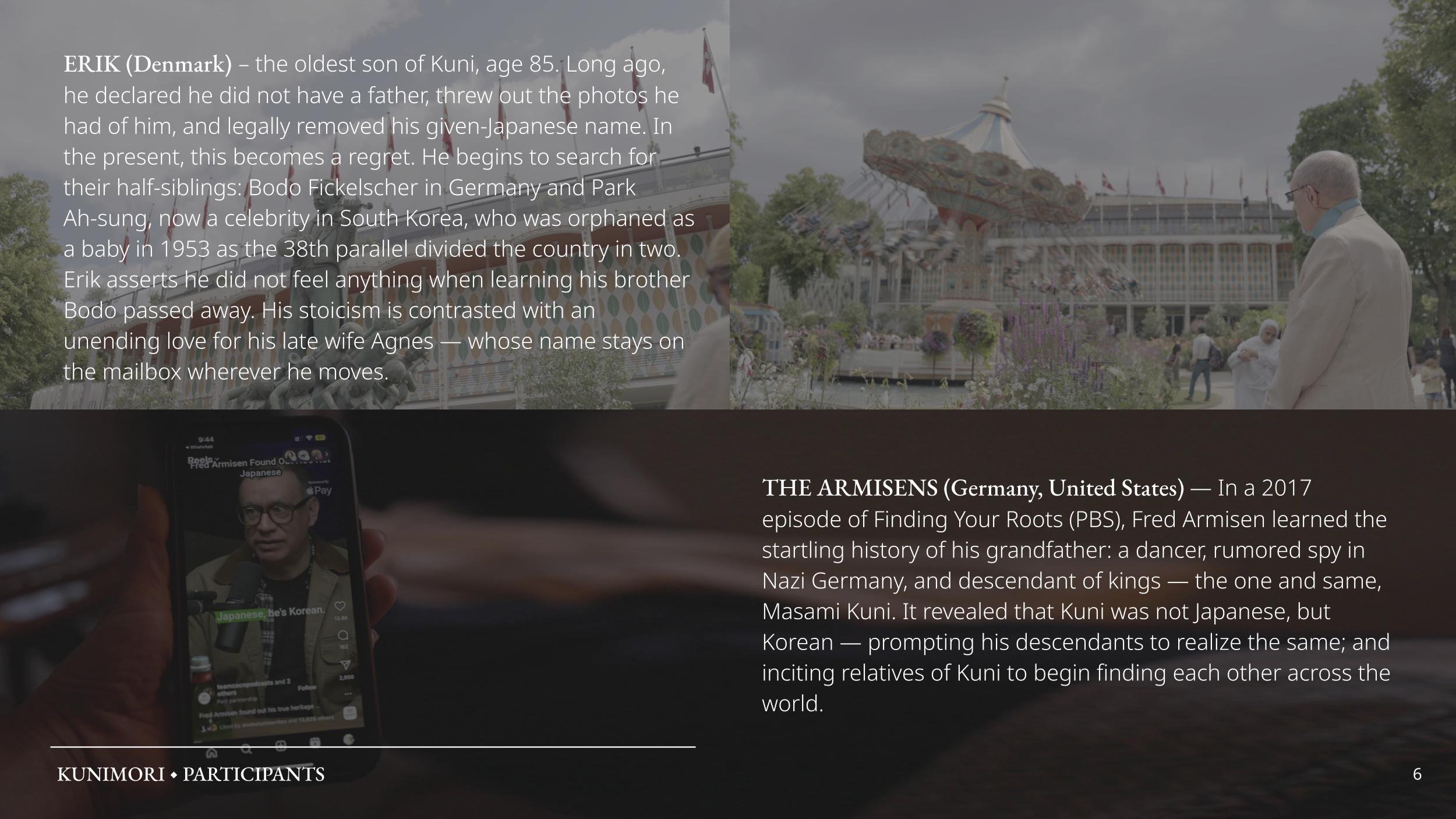
ERIK (Denmark) is the oldest son of Kuni, age 85. Long ago, he declared he did not have a father, threw out the photos he had of him, and legally removed his given-Japanese name. In the present, this becomes a regret. He begins to search for their half-siblings: Bodo Fickelscher was a baker in Germany, and played in a band. Park Ah-sung, now a celebrity in South Korea, was orphaned as a baby in 1953; his early story represents the millions of families separated when his mother traveled to visit her family in northern Korea, just days before the 38th parallel divided the country in two.
Erik asserts he did not feel anything when learning his brother Bodo passed away. His stoicism is contrasted with an unending love for his late wife Agnes — whose name stays on the mailbox wherever he moves.
THE ARMISENS (Germany, United States) — In a 2017 episode of Finding Your Roots (PBS), Fred Armisen learned the startling history of his grandfather: a dancer, rumored spy in Nazi Germany, and descendant of kings — the one and same, Masami Kuni. It revealed that Kuni was not Japanese, but Korean — prompting his descendants to realize the same; and inciting relatives of Kuni to begin finding each other across the world.
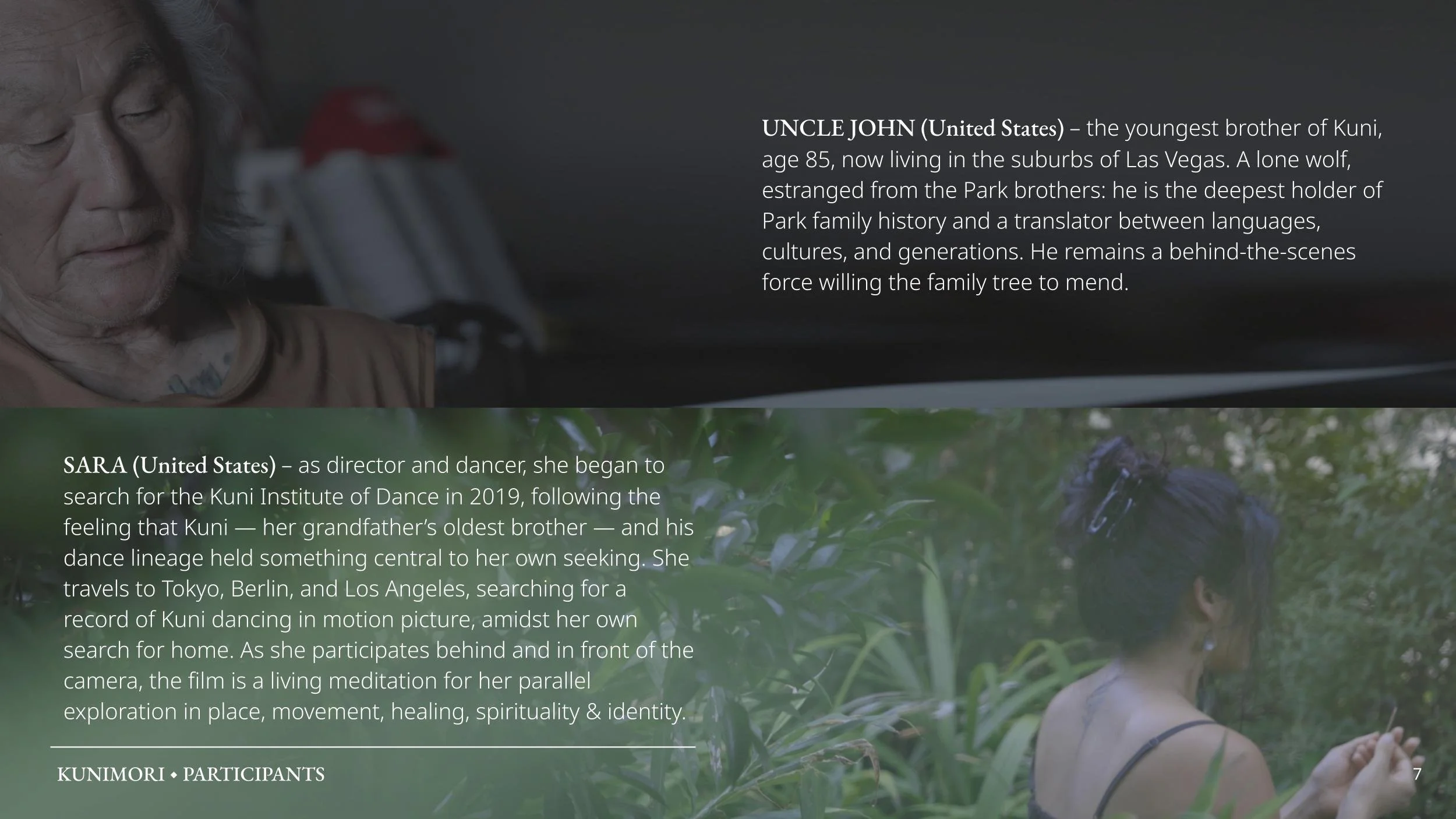
UNCLE JOHN (United States) is the youngest brother of Kuni, age 85, now living in the suburbs of Las Vegas. A lone wolf, estranged from the Park brothers: he is the deepest holder of Park family history and a translator between languages, cultures, and generations. He remains a behind-the-scenes force willing the family tree to mend.
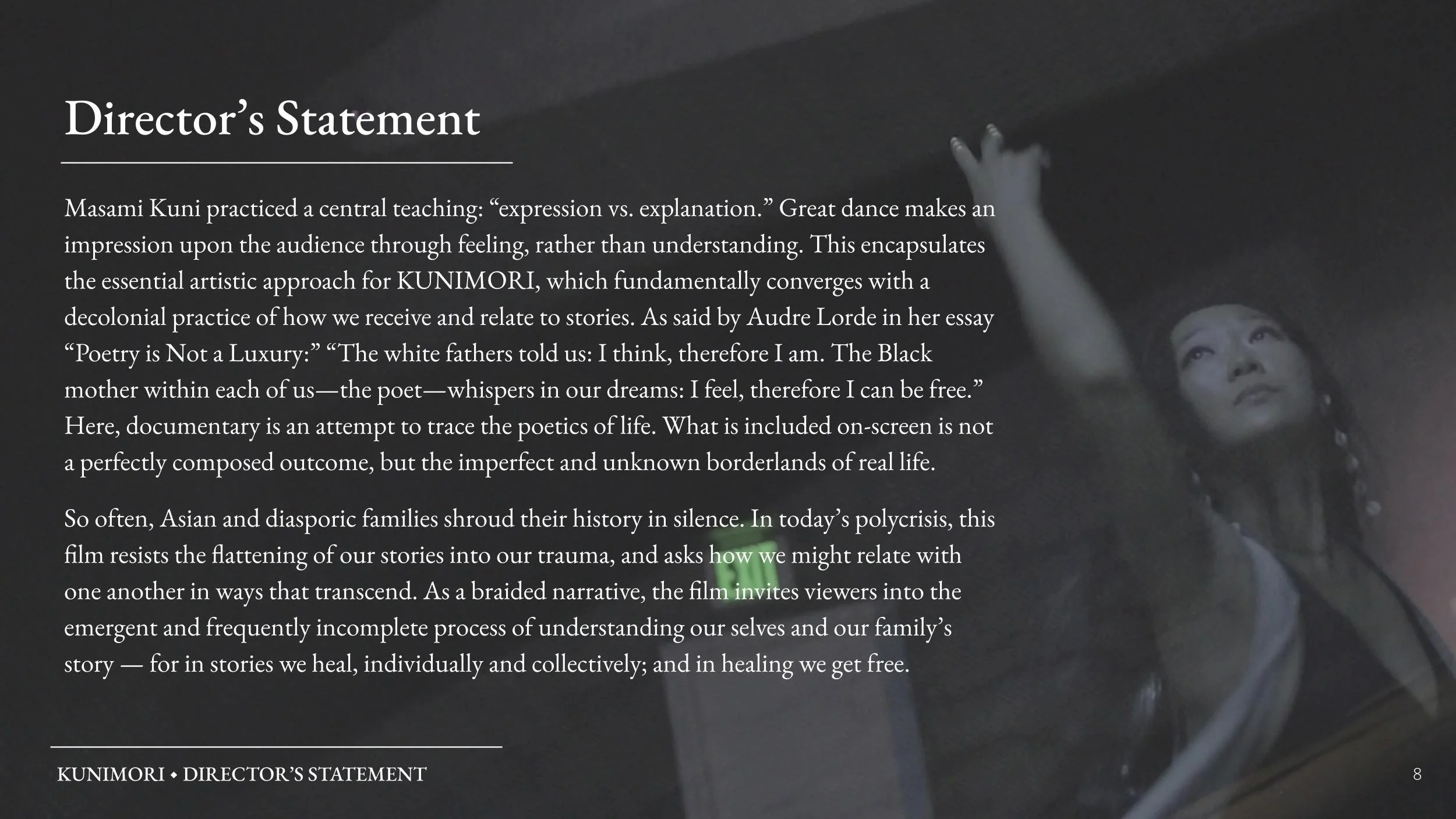
SARA (United States) began to search for the Kuni Institute of Dance in 2019, following the feeling that Kuni — her grandfather’s oldest brother — and his dance lineage held something central to her own seeking. She journeys to central sites of Kuni’s dance teachings (e.g. Tokyo, Berlin, Los Angeles), sifting through his artistic and political practice while searching for a record of Kuni dancing in motion picture. As she participates in family unfoldings behind and in front of the camera, the film functions as a living meditation for her parallel exploration in place, dance, healing, spirituality, and identity.
As a braided narrative, the film follows this ensemble of family members, previously unknown to each other and strewn around the world, as their lives begin to intersect. The film ponders the parallels and intersections across relatives and generations, and how we are connected in ways we may not comprehend.
-
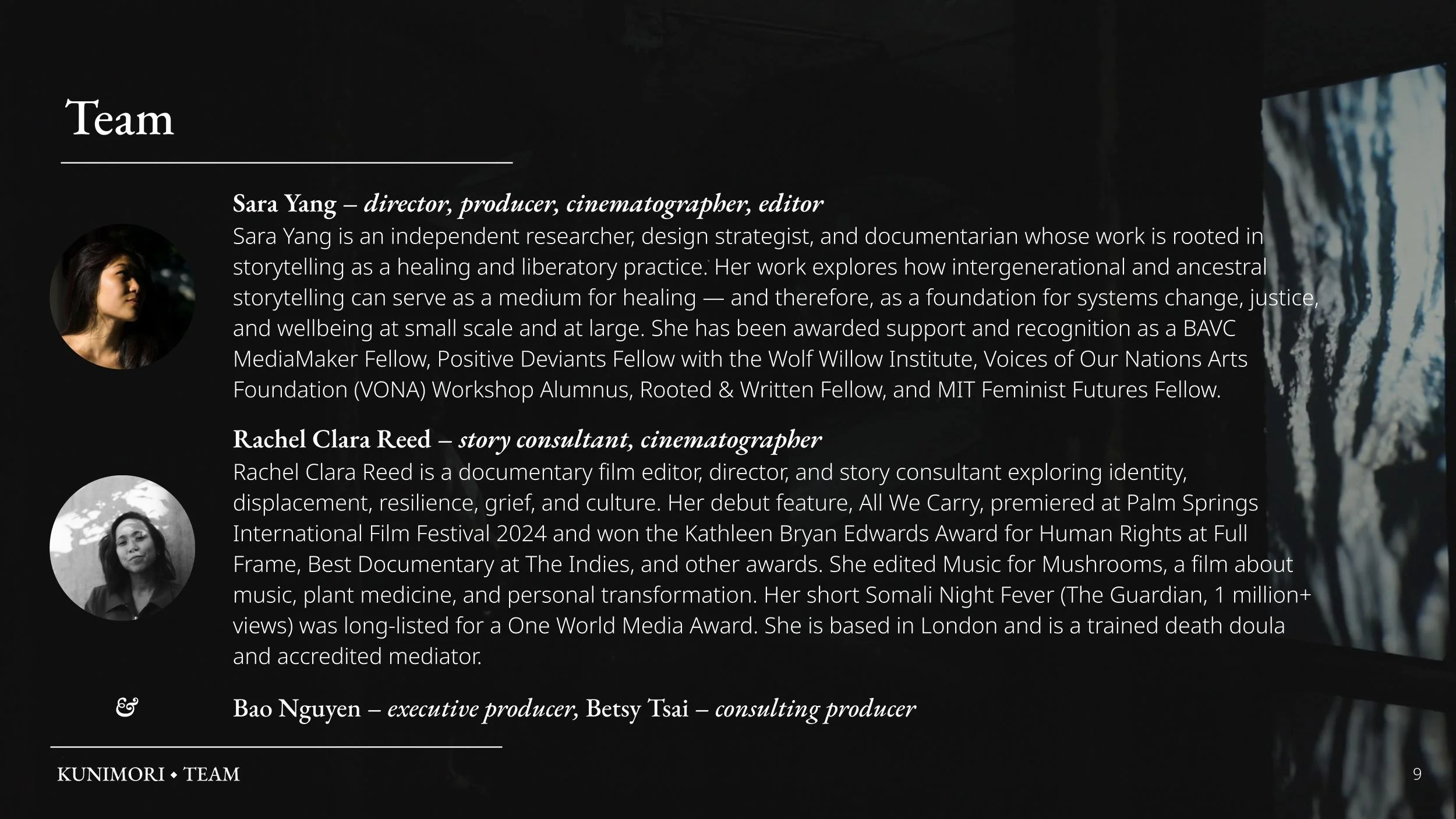
Masami Kuni practiced a central teaching: “expression vs. explanation.” Great dance makes an impression upon the audience through feeling, rather than understanding. This encapsulates the essential artistic approach for KUNIMORI, which fundamentally converges with a decolonial practice of how we receive and relate to stories. As said by Audre Lorde in her essay “Poetry is Not a Luxury:” “The white fathers told us: I think, therefore I am. The Black mother within each of us—the poet—whispers in our dreams: I feel, therefore I can be free.” Here, documentary is an attempt to trace the poetics of life. The film invites viewers into the emergent and frequently incomplete process of understanding our selves and our family’s story. Throughout, dance offers an embodied vantage into the interiority of participants’ lives, illustrating themes of unmasking, expression, relational and intergenerational trauma and healing, and freedom.
As director, cinematographer, and family member, the camera remains a direct extension of my perspective and participation in family unfoldings. Filmed observationally with frequent breaks in the fourth wall, I am present on both sides of the camera: this rejects the filmmaker as objective, instead leaning into transparency and relatedness. There are intentionally no formal or sit-down interviews; the majority is filmed vérité. It embraces the out-of-frame, at times featuring everyday objects with background dialogue — an empty glass on a table, a dimming lamp. They serve as ode to conversations & events that elude the record, both in documentary, and in the process of knowing one’s family history. The pacing is natural, with room for scenes to breathe — inviting viewers into the patience required and experienced by participants as they navigate familial & healing journeys, and functioning as decolonial practice in slow media.
In structure and artistic choices, the film parallels written forms like the zuihitsu or braided essay — gathering distinct yet overlapping storylines from across the corners of the world, and weaving together connections through the mysterious, organic, and associative. The film nods to the East & South Asian narrative tradition of kishōtenketsu (giseungjeongyeol in Korean) where the story is an unfolding of textures, details, and contrast. Threads may braid together, yet subvert conventional closure. By emulating the organic, non-linear, and frequently incomplete process of understanding self, culture, and history, the film invites viewers to preview and practice this process within themselves. Gaps and contradictions are inevitable; not all reasons will be known today. In the context of modernity, where “we are conditioned to want to cover everything with a heavy blanket of fixed meanings” we are invited to relate to stories through resonance, rather than through legibility (Vanessa Machado de Oliveira, Carl Mika). What is included on-screen is not a perfectly composed outcome, but the imperfect and unknown borderlands of real life.
Here, documentary is an attempt to trace the poetics of life. Like a poem, or a dream — not all may be understood on an individual first watch. I am inspired by the work of multi-disciplinary artist Theresa Hak Kyung Cha and the teachings of Dr. Melanie Goodchild, an Anishinaabe systems thinking and complexity scholar, as they make no compromises in their storytelling for the sake of portability. Perplexity makes their work relational by design, as it expects us to engage with it communally rather than transactionally. Through distribution and the impact campaign, viewers will be invited to relate with the film in shared space: allowing for layers to unfurl in communal conversation, and for audience reflections to surpass the film into the realm of the personal. By emulating the organic, non-linear, and frequently incomplete process of understanding self, culture, and history, the film invites viewers to preview and practice this process within themselves – not consuming the lives of the people on-screen, but feeling their journeys in seeking and becoming, in tandem with our own.
Get in touch
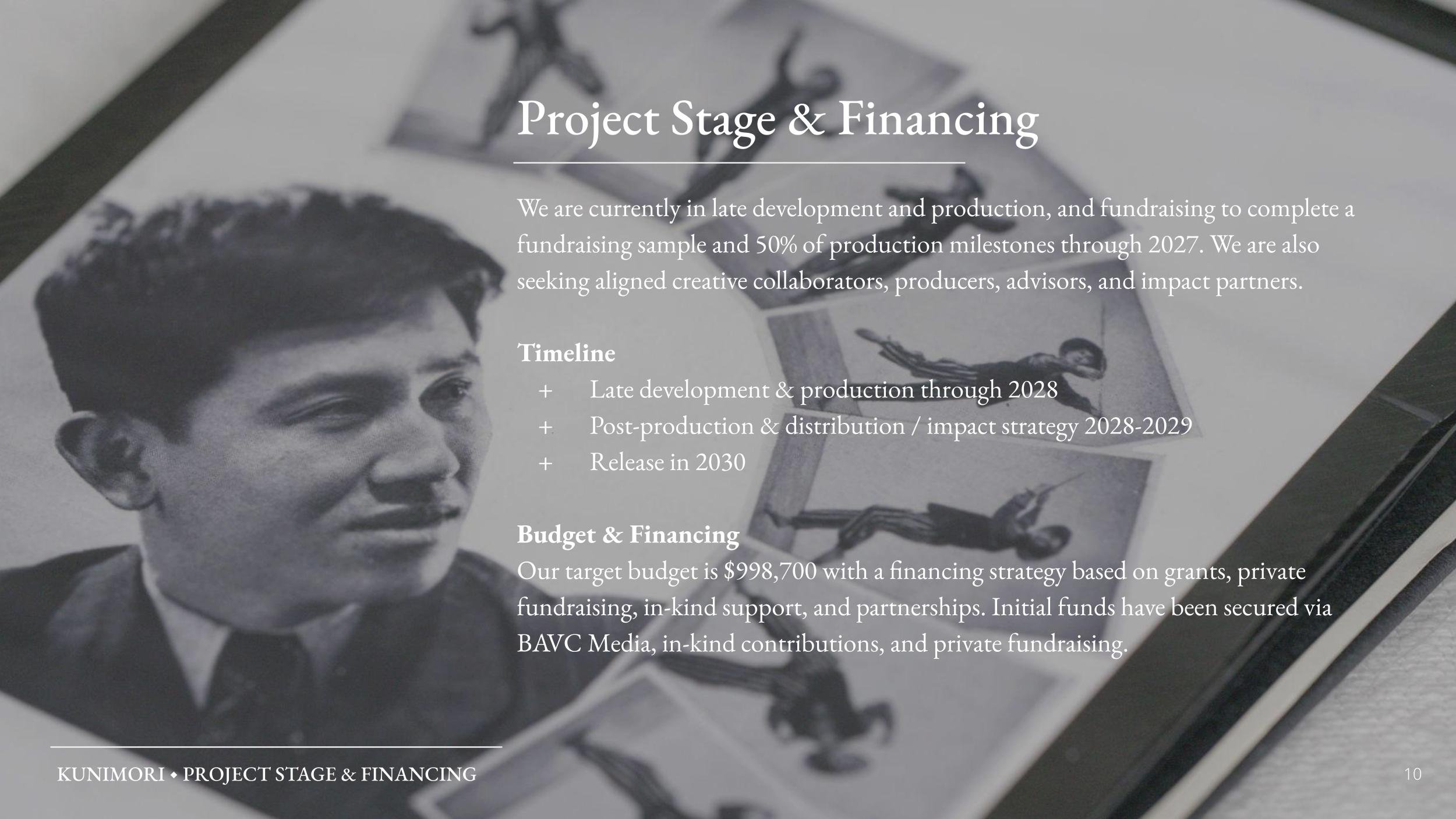
We are currently in production, and fundraising to complete a fundraising sample and 50% of production milestones through 2027. We are also seeking aligned creative collaborators, producers, advisors, and impact partners.
If you resonate with this film’s vision, please reach out at kunimori.film@gmail.com.